Buy anything from 5,000+ international stores. One checkout price. No surprise fees. Join 2M+ shoppers on Desertcart.
Desertcart purchases this item on your behalf and handles shipping, customs, and support to Croatia.
🔍 Find the hidden, fix the broken — never lose a wire again!
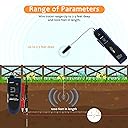
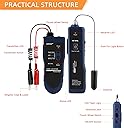
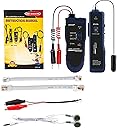
The NOYAFA NF-816L Underground Wire Locator is a professional-grade tool designed to precisely detect buried or hidden cables up to 2.6 feet deep and 1000 feet long. Equipped with a rechargeable lithium battery and an integrated LED flashlight, it excels in diverse environments including electrical, irrigation, pet fences, and network wiring. Its intuitive signal detection and cable break pinpointing capabilities make it an essential device for efficient troubleshooting and maintenance.


| ASIN | B08B14RCZP |
| Best Sellers Rank | #53,091 in Industrial & Scientific ( See Top 100 in Industrial & Scientific ) #88 in Network & Cable Testers |
| Brand | NOYAFA |
| Brand Name | NOYAFA |
| Color | NF-816L with Lithium battary |
| Customer Reviews | 4.0 out of 5 stars 1,254 Reviews |
| Global Trade Identification Number | 06971278907008 |
| Included Components | PCB |
| Manufacturer | Noyafa |
| Model | NF-816L |
| Number of Items | 1 |
| Part Number | NF-816L |
| Power Source | Battery Powered |
| Style | Modern |
| Style Name | Modern |
| Unit Count | 1.0 Count |
S**K
This really works on sprinkler control valve and connecting wire to it from controller.
Best money I spent in a while. I had a buried 20 year old sprinkler valve about a foot underground for the control wire. My irrigation guy used a $1000 locator, and had zero luck finding the valve. Under about 6 inches of grass/mulching accumulation, etc. As a last resort, I pulled this out of the Amazon box and hooked it up. Had to try a few different settings, but found the best for me to be the red wire to the control valve wire, and the black wire to an earth ground on the electrical panel..not stuck in the ground with a screwdriver, etc. Then, playing around with the control on the sender I found a position where I got good clear tone, no static, and a NULL when passing over the wire, which I knew at least where it was starting at the control box where the wires went into the ground. Then I clearly followed it about 100 feet in the yard, getting clean tone-null-clean tone. Either side of clean tone of course was nothing/quiet. So I guess it was quiet-tone-null (nothing)-tone-quiet. MUST look for a null this way...NOT the loudest. If no null, you are not over wire. And no static way off wire.Manual does not address this. Anyway, went directly to the box and lost null if past it.Hit it first time with the diving rod. Dead solid perfect. This thing is great, but have to know how to use it I guess by trial and error. Once you do it, and get moving, easy to find exact final box location by the sound changes there at the box. Kind of hard to explain but the probe was directly over the box where I had the guy test probe. Bingo. And I moved pretty fast following the wire swinging the probe back a forth. And the null is pretty precise so do not swing past it side to side. You will get the feel. I did. This is totally true. Love this as saved me a fortune. Now.....make a drawing and store somewhere as to where the boxes are!!!
A**R
Perfect for finding the dog fence break
Worked like a charm! This is a radio transmitter and receiver. The transmitter connects to the fence wire, and the receiver is an antenna that you wave over the wire. If the wire isn't broken, there's a radio signal for the receiver to pick up and it makes a tone. When you find the spot with no signal, that's the broken spot. Simple and quick. You disconnect the wires from your fence transmitter. Select one of the wires and connect the red alligator clip to it, and connect the black alligator clip to ground (you might need to stick a metal spike in the ground to clip to). Turn on the transmitter and there's a "volume" dial on the side. The transmitter turns the wire into a broadcast antenna. I cranked the volume up better than halfway, which was probably more than necessary. Turn on the receiver and let the cord dangle. There's a "volume" knob on the side for sensitivity. Let the receiver cord and receiver (the "plumb bob) wave over the wire and you'll hear a tone. The tone stops when the receiver is DIRECTLY OVER the wire. That's how you know exactly where the wire is. Let the plumb bob swing and listen to the tone as you walk around the perimeter of the yard. When the tone goes away COMPLETELY, you know you're past the break. A little bit of walking and swinging and it's a piece of cake to find the broken end of the wire within a few inches. It took longer to hook everything up than it did to find the break. Well worth the $$ for a fraction of the price of the name brand pet fence break detector.
C**R
Does the trick!
A fraction of the price of similar tools, and WAY cheaper than hiring someone to come out. There was an dog invisible fence installed on our property when we bought the house, but when I bought the collar and control panel I discovered there was a break in the line. I bought this unit to attempt to find the break. At first I was having a hard time trying to actually "trace" the wire until I realized all I had to do was swing the pendulum left and right while walking the direction of the fence- listening for the beep as the pendulum crossed over the wire. When it stopped beeping, I put marker flag to dig there. Then, I went back to the starting point and hooked the unit up to the other wire and walked the opposite direction until the beep stopped again. I ended up replacing 2 sections of wire about 20' long each.. used waterproof wire nuts with grease caps on each repair and had the fence working in a few short hours.
J**H
Works fine, missing parts
The device seems to work ok; I was able to find the cable I was seeking. The case material is VERY thin and cheap, and the test leads are starting to fray after one use. Definitely not the quality I was expecting for the price. So overall I guess I'd rate it as "fine." I am disappointed, however, that the RJ11 and RJ45 test leads pictured are not included, nor is there anywhere to plug in such leads.
B**R
it works and the signal is very strong
I have no information about the irrigation system in my yard when a breakage happened. I connected the transmitter to the common line and was able to find most of it. I also find #2,#4, #5 and #6 signal lines and valves by this device with no problem. So the device works as expected. I found the damaged connection box then connect all the valves with a new sprinkler cord directly to the control box then everything works correctly. Here is the not-very-good part: the signal on common line stop complete at an area where supposed to be the joint between #1 and #3 valve. No signal for common line, #1 signal line or #3 signal line. I dig a testing trench and found the main water pipe and the common line at about 20 inches deep. This detector was able to receive signal from the dig-out common line but still can't find any signal passing the testing trench. Now the #1 and #3 valve works correctly but this device just can't pick up the signal. May be the line was buried too deep? Anyway, this device works just fine and can detect signal as deep as about 15-18 inches. For more then 20 inches applications, you may need a more powerful device, which may cost you several hundred dollars.
S**E
Worked for a few minutes
I would have given it one star, but it did work for a few minutes . Had to return. I spent $125 on one that worked great.
F**D
Over priced cheap junk
I purchased this less than 2 1/2 months ago. I used it when I first received it to trace a wire under a sidewalk, it took some fiddling but it did work. 4 days ago I got it out again to help a friend, it would not make any sounds when I turned it on. I had stored it in the pouch in a drawer with the batteries out. I tried 2 sets of batteries and neither worked. It was past the 30 day return window but Amazon had a button to get "expert help". The person or bot I chatted with at Amazon was totally clueless as to what this even did. They kept telling me to "try it with a different item", do idea what that means. Then they told me the item is defective and covered by a manufacturer warranty, and gave me an email to send the complaint to with my order information. 4 days now still waiting on a reply. When this worked it had marginal performance at best. It was able to trace the wire but took so much fiddling that it did not instill any confidence. The case is made out of the cheapest plastic I have ever seen on any tool, Think thin styrene plastic like on a plastic model car kit. The fact it did not last for more than one use makes this incredibly over priced. Save time money and hassle. Buy a better unit that is at least supported by the manufacturer.
M**R
Great product; worked easily to find break in dog's Invisible Fence
Product worked great to find a break in my dog's Invisible Fence wire. I have about an acre, and it had no problem holding a strong signal while I traced the wire. It held a high pitched whine until about 10 feet on either side of the break, when the sound drifted from a whine into a staticky crackle. Took about 20 minutes to then find and repair the break. Remember, the whine is audible on either side of the wire, but goes silent directly over the wire. This device had no problem finding the wire. I attached the black clip to a wire that I wrapped around a large screwdriver which I stuck in the ground. I attached the red wire to one of the dog fence wires. Remember to disconnect the dog wire from the Invisible Fence transmitter before starting. I found that putting the NOYAFA on either cable locator or battery check worked fine. It's a cheapy tool, but did the trick and saved $$$ in having an Invisible Fence tech come out. Thanks to the other reviews for helping me get on the right track.
P**R
Gekauft, Gesucht, Gefunden!
Mein Mähroboter zeigte mir an, dass er kein Schleifensignal mehr hat. Ok, also beide Enden der Schleife mit einem Multimeter auf Durchgang überprüft. Siehe da, irgendwo ein Kabelbruch. Ich habe zuerst angefangen an mehreren Stellen das Kabel aufzugraben und immer wieder auf Durchgang zu überprüfen, so konnte ich die betroffene Stelle schon mal auf 10 Meter genau einschränken. In der Hoffnung genau die richtige Stelle zu finden habe ich dann bei Amazon dieses Gerät gekauft. Nach einem Tag konnte ich weiter machen. Kurzerhand das Gerät ausgepackt, zwei 9V Block Batterien eingelegt, jeweils in den Sender und in den Empfänger. Das schwarze Kabel des Senders habe ich dann mit einem großen Nagel im Boden geerdet. Das rote Kabel an die zu messende Leitung geklemmt. Den Sender eingeschaltet und mit dem Empfänger die Leitung abgesucht. Über den Lautstärkeregler am Empfänger kann man dann schön die Empfindlichkeit einstellen, oder halt die Lautstärke des Pfeiftons. Nach ca. 7 m Meter habe ich dann die Stelle gefunden. Dabei musste ich dann den Lautstärke Regler wieder voll aufdrehen, der Pfeifton endete an einer Stelle auf 10 cm genau. Also die Stelle mal untersucht, ca. 20 cm aufgegraben, aber zu meiner Enttäuschung kein gerissenes Kabel gefunden. Mit dem Gerät nochmals das aufgegrabene Kabel geprüft, es musste die Stelle sein. An dem vergrabenen Kabel nochmals leicht gezogen, „plong“ und das Kabel ist durch die zu hohe Spannung gerissen. Wahrscheinlich hat sich der Boden an der Stelle gesetzt und das Kabel langsam gedehnt. Das Kabel habe ich dann jeweils 5 cm an der abgerissenen Stelle abgeschnitten und wieder repariert. Auf Durchgang überprüft, kurzer Test, nun läuft mein Mähroboter wieder. Fazit: Ich kann das Gerät für den Preis Bestens Empfehlen. Wenn mal wieder angezeigt wird, dass kein Signal vorhanden ist, habe ich jetzt immer ein Gerät für die schnelle Suche nach dem Fehler zu Hause.
P**D
ce petit outil est génial !
D'accord avec l'ensemble des commentaires: quand on le déballe ça fait un peu "cheap" comme appareil, avec du plastique de mauvaise qualité et une impression de jouet-gadget, mais ça fait le boulot avec une précision au centimètre. Essayé dans mon jardin de 6000 m2 avec 400 m de cable enterré. J'avais déjà essayé la radio AM mais ce n'est pas pratique, ça capte tous les fils enterrés sous tension sans distinction, ce n'est pas précis mais j'avais grossièrement localisé la coupure avec une précision de 5 à 10 m, pas génial. J'ai donc essayé ce petit appareil et là , miracle. J'ai trouvé la coupure pil-poil au centimètre près. J'ai fait un trou dans la terre de 10 cm de diamètre juste au niveau de la coupure... bluffant ! S'il faut trouver un défaut, c'est vrai que le signal s'affaiblit beaucoup avec la longueur de cable. Après 250 m il n'y a presque plus rien. A recommander à tous ceux qui ont un robot-tondeuse avec fil enterré, parce que le délai d'intervention d'un technicien est plus long qu'une commande-livraison en 48h, sans parler du prix ! Dernière précision, dans mon cas la coupure était sur une ligne droite sans obstacle, ni taupe ou mulot. ça a cassé net on ne sait pas pourquoi, mais probablement à cause de la sécheresse qui a tendu le fil à mort. Donc ça peut se reproduire et je garde l'appareil au chaud
I**B
Inutile, gadget
Il m’a été impossible de trouver la coupure du fil périphérique de robot de tonte. Le comble c’est qu’il n’indiquait qu’il n’y avait pas de coupure une fois le périmètre terminé. Mais la coupure y était comme indiqué sur la base. À plusieurs reprises il arrêtait de biper, donc je creusais, mais il n’y avait rien. J’ai fais la taupe 4 ou 5 fois, puis j’ai abandonné. J’ai demandé à un professionnel qui m’a dépanné en 15 mn. Je lui ai montré l’appareil qu’il a testé et après avoir simulé une coupure sur un fil enterre sous 3 cm, le résultat était sans appel, l’appareil n’a rien trouvé. Le technicien a rigolé et ne s’est même pas donné la peine de de donner un commentaire. J’aurais dû me fier à plusieurs commentaires qui ont eu la même expérience. Appareil NUL.
D**H
Not for me
It did not do as I expected. It could not tell me if there was a break in my auto mower boundary.
L**A
ogĂłlnie dobrze
Używam go do wykrywania przerw w kablu granicznym mojej Gardena Sileno robot kosiarki. Aby detektor był skuteczny, trzeba się do niego przyzwyczaić. Dwie ważne rzeczy do zapamiętania: 1) Utrzymuj niezbyt wysoki poziom głośności odbiornika, w przeciwnym razie głośnik będzie nasycany hałasem. 2) Wbij śrubokręt w ziemię z dala od innych źródeł sygnałów. Podłącz czarną wtyczkę nadajnika do śrubokręta, a czerwoną wtyczkę do kabla. Jeśli tego nie zrobisz, nie otrzymasz żadnego sygnału!
Trustpilot
3 weeks ago
3 weeks ago