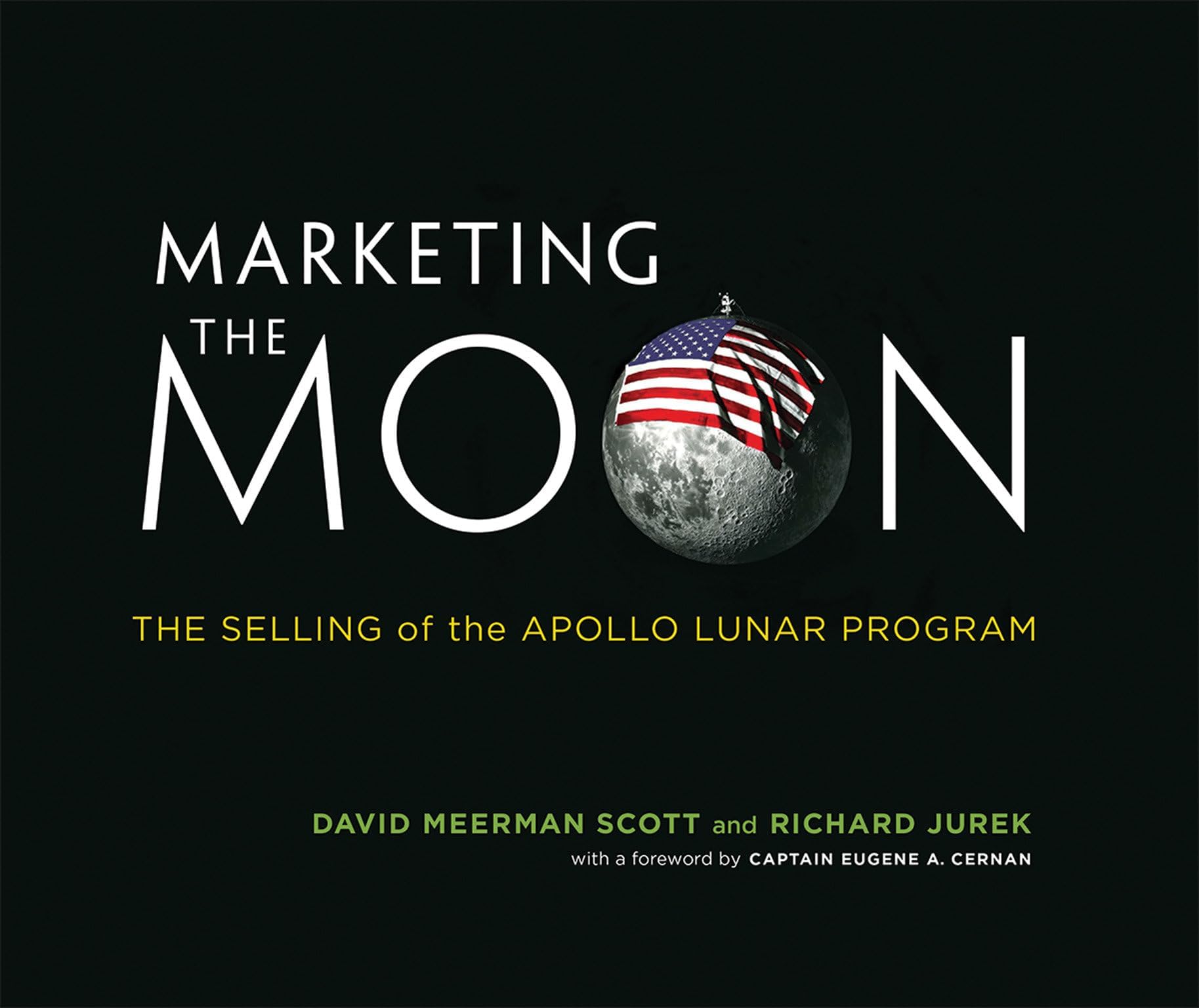
Marketing the Moon: The Selling of the Apollo Lunar Program (Mit Press)
Product ID: 1704814
Buy anything from 5,000+ international stores. One checkout price. No surprise fees. Join 2M+ shoppers on Desertcart.
Desertcart purchases this item on your behalf and handles shipping, customs, and support to Croatia.
Marketing the Moon: The Selling of the Apollo Lunar Program (Mit Press) [Scott, David Meerman, Jurek, Richard, Cernan, Eugene A] on desertcart.com. *FREE* shipping on qualifying offers. Marketing the Moon: The Selling of the Apollo Lunar Program (Mit Press) Review: Informative, somewhat sobering view of the Sapce Race - Even as an older child (I was seven when Shepard lifted off) I was aware that most people did not share my enthusiasm for space exploration in general and manned space flight in specific. After reading "Marketing the Moon" I now know why. For most Americans Apollo was pretty much the home-team fans leaving the stands at the end of the third quarter because they knew their team would win. Well, I already knew that, but Scott and Jurek demonstrate the depth of disinterest to a level new to me. I guess I know how Linus felt trying to convince his friends of the great Pumpkin - or something like that. In their book the authors display how NASA PR, industry and consumer companies, and the three major TV networks kept America's space efforts front and center for all of the 1960s as the events were happening (this angle was in diametric opposition to the mostly closed Soviet program). As well, for all of the 1950s private media, most notably Collier's magazine and the Walt Disney Company, pushed the idea of manned space flight to a receptive population. As events turned out that reception and anticipation was for the most part shallow and fleeting. Once the goal was accomplished, for those on Capital Hill, in the boardrooms of NBC, CBS and ABC, and on Main Street the game was over. The black-and-white TV images from the early Apollo missions were barely passable. The later missions broadcast excellent color signals in real time, but no one in the general population saw those live broadcasts - the networks wouldn't carry them. NASA PR wasn't able to keep its brand from crashing. This is an excellent book in content, lavishly illustrated and well laid out. It's a must read for any space cadet. It is easily paired with Megan Prelinger's "Another Science Fiction - Advertising the Space Race 1957-1962," also excellent. Review: Terrific - This terrific book is both entertaining and informative. Beginning with the formation of NASA the authors explain how the agency found its voice, how the decision was made to be honest and transparent and how the writers thought of themselves as reporters instead of public relations people ("We put out news releases, not press releases.") The role of television, arguably the most important aspect of marketing the flights, is handled well by explaining both the political and technical challenges of the time. And the topic of astronauts as celebrities is explored at depth with surprising conclusions. The book contains wonderful photos of commercial ads, technical manuals and marketing pieces from NASA and their contractors during this time. These items, many from the authors' personal collections, are a highlight of the book. There are also many interesting personal anecdotes in the book, from the reasons Paul Haney quit his job to an incident involving Neil Armstrong's parents which reveals much about Neil himself. We all know how the story ends - the public and media lost interest rapidly after the first landing, missions were cancelled and we haven't returned to the moon since Apollo. This was actually a failure of marketing by NASA to keep the public engaged, and this aspect of the program is covered as well. I couldn't put the book down. Highly recommended.
| Best Sellers Rank | #1,220,132 in Books ( See Top 100 in Books ) #1,184 in Astrophysics & Space Science (Books) #2,649 in Communication & Media Studies #3,401 in History & Philosophy of Science (Books) |
| Customer Reviews | 4.7 4.7 out of 5 stars (65) |
| Dimensions | 9.81 x 0.73 x 11.38 inches |
| Edition | Illustrated |
| ISBN-10 | 0262026961 |
| ISBN-13 | 978-0262026963 |
| Item Weight | 2.36 pounds |
| Language | English |
| Print length | 144 pages |
| Publication date | February 28, 2014 |
| Publisher | The MIT Press |
F**S
Informative, somewhat sobering view of the Sapce Race
Even as an older child (I was seven when Shepard lifted off) I was aware that most people did not share my enthusiasm for space exploration in general and manned space flight in specific. After reading "Marketing the Moon" I now know why. For most Americans Apollo was pretty much the home-team fans leaving the stands at the end of the third quarter because they knew their team would win. Well, I already knew that, but Scott and Jurek demonstrate the depth of disinterest to a level new to me. I guess I know how Linus felt trying to convince his friends of the great Pumpkin - or something like that. In their book the authors display how NASA PR, industry and consumer companies, and the three major TV networks kept America's space efforts front and center for all of the 1960s as the events were happening (this angle was in diametric opposition to the mostly closed Soviet program). As well, for all of the 1950s private media, most notably Collier's magazine and the Walt Disney Company, pushed the idea of manned space flight to a receptive population. As events turned out that reception and anticipation was for the most part shallow and fleeting. Once the goal was accomplished, for those on Capital Hill, in the boardrooms of NBC, CBS and ABC, and on Main Street the game was over. The black-and-white TV images from the early Apollo missions were barely passable. The later missions broadcast excellent color signals in real time, but no one in the general population saw those live broadcasts - the networks wouldn't carry them. NASA PR wasn't able to keep its brand from crashing. This is an excellent book in content, lavishly illustrated and well laid out. It's a must read for any space cadet. It is easily paired with Megan Prelinger's "Another Science Fiction - Advertising the Space Race 1957-1962," also excellent.
G**M
Terrific
This terrific book is both entertaining and informative. Beginning with the formation of NASA the authors explain how the agency found its voice, how the decision was made to be honest and transparent and how the writers thought of themselves as reporters instead of public relations people ("We put out news releases, not press releases.") The role of television, arguably the most important aspect of marketing the flights, is handled well by explaining both the political and technical challenges of the time. And the topic of astronauts as celebrities is explored at depth with surprising conclusions. The book contains wonderful photos of commercial ads, technical manuals and marketing pieces from NASA and their contractors during this time. These items, many from the authors' personal collections, are a highlight of the book. There are also many interesting personal anecdotes in the book, from the reasons Paul Haney quit his job to an incident involving Neil Armstrong's parents which reveals much about Neil himself. We all know how the story ends - the public and media lost interest rapidly after the first landing, missions were cancelled and we haven't returned to the moon since Apollo. This was actually a failure of marketing by NASA to keep the public engaged, and this aspect of the program is covered as well. I couldn't put the book down. Highly recommended.
A**N
MARKETING THE MOON
Marketing The Moon .. nice and lovely book or I would call it a personal moon museum .. it is indeed a museum on your hand about everything related to the Apollo moon mission.
S**H
Every American Should Read This Book!
I've read most of the space books that are out there. But this book I could not put down until I finished it. It is so much more than a history of our space program or a description of the marketing principles that NASA used. It is really a truly unique examination of the amazing national effort that resulted in the greatest scientific feat of all time - and how the ordinary citizen from age 8 to 80 became an integral part of it all! I learned so much from reading Marketing the Moon. This story made me feel proud to be an American and at the same time left me wondering - why can't we get the public behind a similar effort today? Rich Jurek and David Meerman Scott bring a totally fresh perspective to our space program with many very cool photos, images and "back stories" never seen or heard unitil they reached this book. Every American should read this book -- especially during this time where leadership and direction seems to be lacking - to see that it CAN be done again....that we really DO have the capability to take on a big project or goal and get our country aligned in the same unified direction. An absolute must read!
M**B
Brings the story alive again through a fresh perspective!
Awesome book and well worth the price. If you are a fan of space and the race to the moon in the 60's, "Marketing the Moon" is a must. I have read many books about that era and I must say this provides a fresh angle that I had not thought about before. Lots of pictures/images and insights that were new to me and they made the story of that time come alive again! Perhaps you are not a student of the space race but are looking at this as more of a marketing case study. If that is the case, I would also highly recommend, as after reading the book, I would say it is indeed true that this was the most significant marketing campaign ever undertaken. This is a book you won't want to put down. It also looks great as a "coffee table" book. Highly recommended!
A**R
Fascinating Reading
This book kept my attention from beginning to end! I'm old enough to have seen the space program evolve over the years, and it was amazing to read about it again and to get an insight into what went on 'behind the scenes'. The book is chock full of wonderful photographs and articles. Authors David Meerman Scott and Richard Jurek are to be applauded for a job well done! Great reading for both old and young......
A**H
Bellissimo, per chi è appassionato ai retroscena, qui c'è spiegato tutta la macchina di marketing avviata per sostenere e creare l'immaginifico dell'impresa per la Luna, un ottima case history. Nasa & MIT, materiale di prima mano e di qualità di difficile reperimento.
B**D
Excellent recount of the behind the scene marketing that was going on at the time. Meeting President Kennedy's goal of sending a man to the moon was truly a national effort, it is reflected in the endeavours of all those who participated. The U.S. needs another such "bold" challenge. Excellent book that accounts for that time, I recall the excitement of growing up during that period and being one one of the many observers being glued to the television.
H**S
In Houston it was Sunday, July 20, 21:56, 1969. In the Netherlands, it was Monday, July 21, 03:56 in the night. This was the moment when Armstrong made his first steps on the moon. I have experienced that moment because there were live TV images from the moon. ‘Marketing The Moon’ is not a dry list of successes and failures during NASA’s Apollo space program between 1961 and 1972. The book is filled with stories, photos, anecdotes personal notes, advertising, covers of magazines, images from NASA films, newspaper clippings, TV-screenshots, facts, opinions and prototypes of equipment. Much of this material was new to me. There is also a chapter devoted to the construction of the TV cameras that were taken to the moon at the time. In short, as this period in history interests you then this is a valuable book to read.
O**R
Great (and beautiful) book. As someone else said here or elsewhere, if for some totally unbelievable reason the moon landings were found to be faked (which of course they are not) then this is the one book which wouldn't need a rewrite! Fascinating to see the literary impetus for space exploration and also how success ultimately breeds failure - in that the marketing of the space program was a victim of its own success. One of the central tenets of this book is that the (American) public got so into it that once Armstrong had set foot on the moon and moonwalking became a technical commonplace, that was curtains for NASA. Turning the excitement of space travel into the mundanities of where are you going to have a dump and 'oo, look at that rock' geology, meant that it wouldn't be too long before we all had our heads turned by the Jackson 5, Happy Days and - oh yes - Watergate, Vietnam and international terrorism . . . Roll on the mission to Mars!!
S**T
Very happy with the book but FYI it’s not a coffee table size if that’s what you’re looking for.
Trustpilot
2 weeks ago
4 days ago