
DOWNLOAD THE APP


Customer Services
Copyright © 2025 Desertcart Holdings Limited
DOWNLOAD THE APP

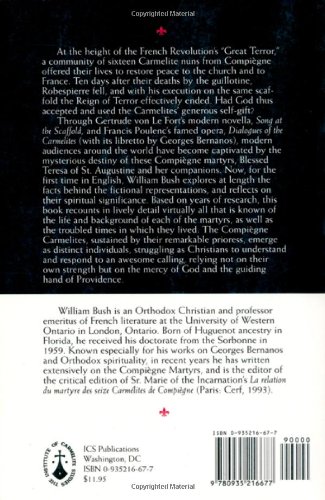
To Quell the Terror: The True Story of the Carmelite Martyrs of Compiegne
B**E
To Quell the Terror: the True Story of the Carmelite Martyrs of Compiègne
To Quell the Terror: the True Story of the Carmelite Martyrs of Compiègneby William BushWashington, D.C.: ICS Publications/ Institute of Carmelite Studies, 1999Pp. xxiv, 243. Paperback.Review by Reverend Brian Van Hove, SJAlma, MichiganPublished in The Fellowship of Catholic Scholars Quarterly, vol. 24, no. 1 (Winter 2001): 50Sixteen Carmelite nuns were guillotined on a hot July night in 1794. Their story is presented by a professor of French literature who, as a fervent Eastern Orthodox Christian, has a particular interest in the theme of martyrdom.In a deliberate act of community or corporate martyrdom, the nuns make a sacrifice of their lives for a two-fold intention. First, to meet the eternal Bridegroom to whom they have dedicated themselves, but also as a petition to God to bring peace back to France and to intercede for so many others imprisoned and condemned.Mysteriously, ten days after the nuns died, Robespierre fell from power and the Great Terror ended. The nuns could have saved themselves, but chose to die instead. The crowd who watched them mount the scaffold was moved in a way which was not typical for those who beheld such routine executions. The Carmelites sang psalms and canticles until finally the last one, the prioress, was herself silenced by the guillotine.Surely between the seventeenth-century Jesuit saints of New France and the newest French saints of the Boxer Rebellion era, there is no more moving account of voluntary martyrdom than that of the Carmelites of Compiègne. Professor Bush has researched their individual backgrounds from a variety of contemporary and later sources. But the collective nature of this sacrifice is the most important aspect of it. They had been condemned as fanatics.The Public Prosecutor of the Revolutionary Tribunal was unwilling to define for the nuns what "fanatic" meant, but eventually he admitted that it was their "attachment to their religion" [p. 63] which made them criminals and annihilators of public freedom. Thus, they are true martyrs for the faith despite anything else which might be said of their breeding, social class, or political preferences. The clarity and perfect freedom of their self-oblation struck the officials of their time as a waste, as it does to the officials of any age who see faith itself as a waste. But the French nuns in the Teresian tradition saw themselves as missionaries and witnesses to truths which could not be attested to in any other way than by a transcendent defiance of death.[There is one curious error on page 111 in the reference to the abbé Aimé Guillon's book Martyrs for the Faith published in 1821. The text should read it was dedicated to Pius VI, not Pius XI.
A**N
Good Historical Contexts
I purchased this book to help my preparation for performing "Dialogues of the Carmelites" and it was incredibly helpful. Getting the historical background on the Carmelite sisters was more important to me than reading a fictional story, though I read "Song at the Scaffold" after I finished "To Quell The Terror" and the two go quite well hand-in-hand. It was interesting to see the different connections the Carmelites actually had to the French monarchy, and I appreciated that William Bush delved a little into the personalities of the sisters. My only issue with the book is that I feel the chapters could be organized more effectively. I went into my research knowing very little about the Reign of Terror, and while I appreciated the book diving right in to the story of the nuns, it would have been helpful for me to know about the time period itself, which isn't discussed until much later in the book (Chapter 6, I believe). The sections tend to jump around too, from one sister to another, and then to different times referred to previously in the book (or alluding to future sections without any real need). Other than that, I found it to be a great help to my research, and I recommend it to anyone who is preparing to perform the opera, as well as anyone interested in the history of the Reign of Terror itself.
T**R
Truly Inspiring
This is one of the most moving and inspiring books I've read in a long time. The author does a brilliant job in bringing all the historical evidence of the truth together of these nuns' lives and martyrdom.I had no idea that the fictionalized versions of these events were so far off until I read this book. I now have an entirely new perspective of these events.When I finally reached the end of the book, I was greatly disappointed that there wasn't more. I wanted more.But, reality being reality, I had finished. So, I just sat for awhile contemplating the nuns' martyrdom and how they knew, two years in advance, that this was going to happen.I was so inspired. The way society has fallen in the past few decades and with recent events from Supreme Court rulings to the way state governments are bullying Christians, I know that soon--perhaps in just one more generation, that Christians here, in the USA, will be called to a similar martyrdom. And I wonder how many of us will be as brave and determined to not give in to the evil one.By the way, I only have one problem with this book: the date on the book says July 17, 1774. It was actually 1794. Otherwise, the book is really fantastic.
L**N
ultimate book on compiegne martyrs
This is a first-rate book, made important by intense and impeccable scholarship, and as well by genuine devotion on the author's part (himself an Orthodox Christian and an academic). William Bush's unadorned and concentrated understanding of the mystery of sacrifice hands this book a beautiful and finally essential aspect in revealing the holocaust of sixteen nuns against even Reason - Who bore the sons that made the madness. Bush wisely makes a book about more than religion and murder, and creates a perfect moving stream out of tidal events, making an awfully effective read. He takes especial pains to dissect the coming about of the holocaust from the view of innocents; the proposition of the choice to be made, the preparation, he even enters the interior lives of the Prioress and Mistress of Novices - aristocratic women living out the literal meaning of privilege. By keeping to the truth, Bush proves these women's gain of discernment and transparency, the silent witnessing so despised by the disciples of the Terror. This is a big book in a relatively thin guise. The author makes too much of the importance of Gertrude von Le Fort's fanciful tale, but his own commanding scholarship speaks for itself, and nothing can diminish the effectiveness of a magnificent effort. The cover bears a daring and beautiful photo of an oblation scene from a production of 'Dialogues of the Carmelites'.
M**S
French Revolutionary Excess
After the wonderful performance at the Royal Opera House this had to be purchased, but this recording still doesn't convey all the horror experienced during the time of The Terror..
J**B
The heroic martyrdom of these Catholic nuns
Used for personal reading. It is a harrowing story about a group of Carmelite nuns during the French Revolution preparing to go to the guillotine.
V**G
To Quell the Terror
Sometimes slightly confusing read but full of in depth research, background information and vivid description from contemporary accounts of the martyrdom of the Carmelite nuns of Compiègne during the French Revolution. Much fascinating information regarding the progressive stages of the Revolution etc.
Trustpilot
2 weeks ago
5 days ago